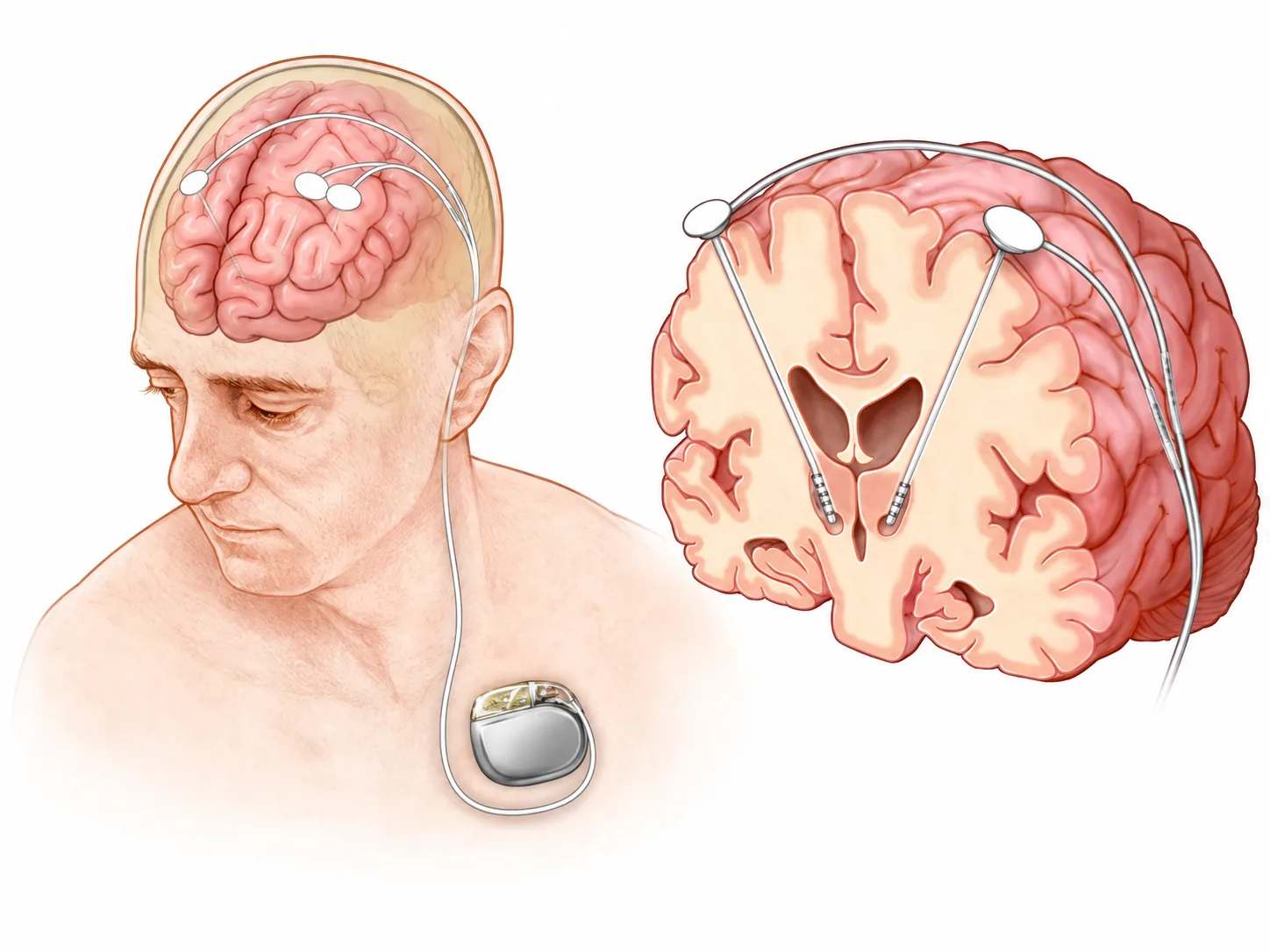
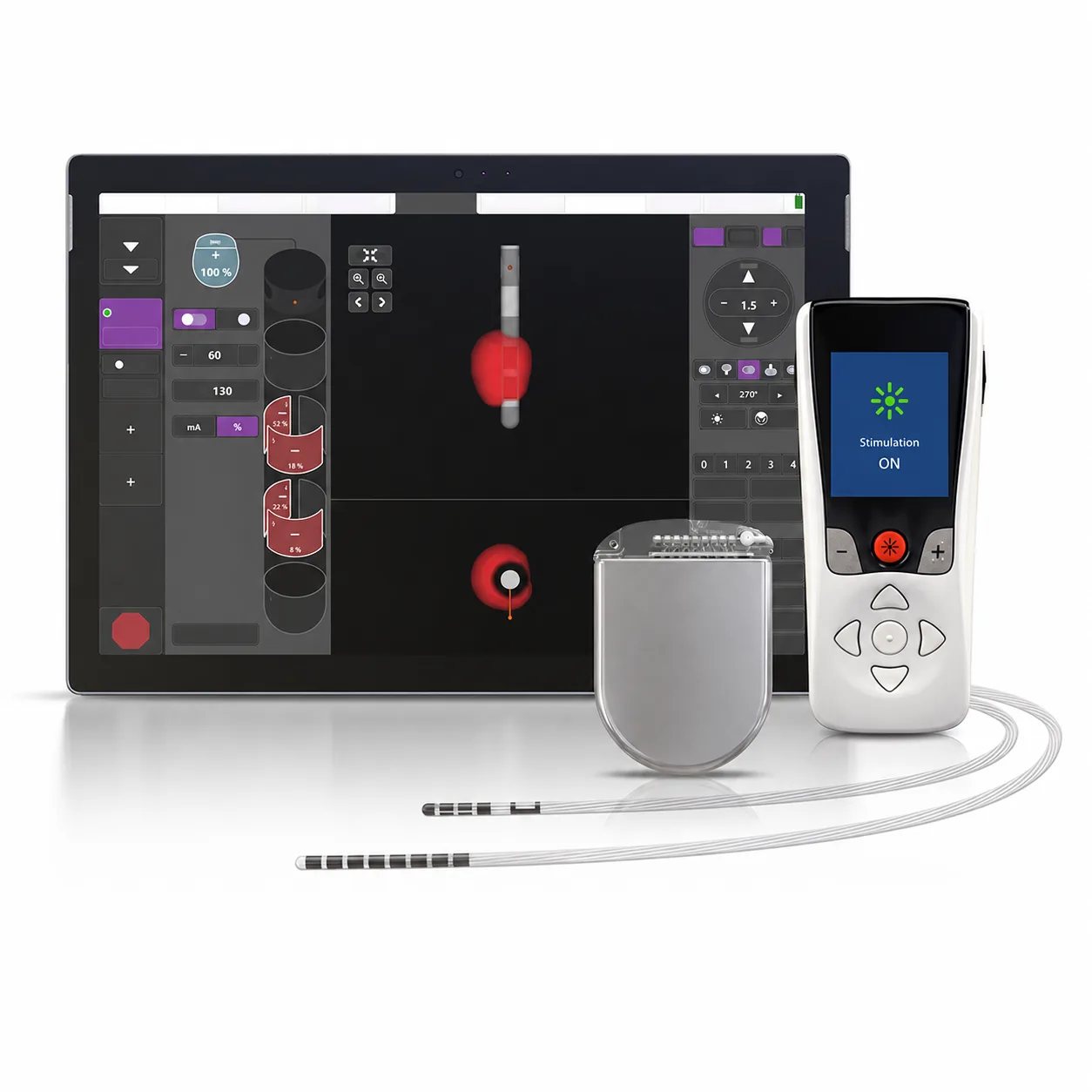
Deep brain stimulation, often called a “brain pacemaker”, is an advanced neuromodulation treatment used particularly for movement disorders. Fine electrodes are placed in specific brain regions related to the condition and connected to a stimulator placed under the skin, usually in the chest.
Low-level electrical stimulation can help regulate brain circuits that are functioning irregularly because of disease. This may reduce tremor, rigidity, slowness, involuntary movements or abnormal muscle contractions.
DBS does not remove or intentionally damage brain tissue. An important advantage is that stimulation can be adjusted to the patient’s needs and switched off if needed.
A DBS system consists of brain electrodes, connecting leads and a pulse generator in the chest.
How Is DBS Performed?
The treatment system has three main parts:
Fine electrodes placed in the target region of the brain
Connecting leads that run under the skin from the electrodes to the stimulator
A battery or neurostimulator usually placed under the skin of the chest below the collarbone
Detailed brain imaging is performed before surgery. According to the patient’s condition, symptoms and treatment goals, the appropriate brain target is selected with millimeter-level precision. Stereotactic surgery and advanced imaging methods are used to place the electrodes.
Surgery may be performed under general anesthesia or with controlled sedation in which the patient is awake for selected stages. The method depends on the condition, target brain region, general health and the surgical team’s plan.
After surgery and the initial healing period, the device is programmed. The first setting is usually not the final one; several follow-up and programming sessions may be needed to achieve the greatest benefit with the fewest side effects.
DBS settings are tailored by the specialist team according to symptoms and treatment goals.
Conditions That May Be Treated With DBS
Parkinson’s disease
Parkinson’s disease is one of the conditions most frequently treated with DBS. It may be considered particularly for patients who obtain a clear benefit from medication but experience motor fluctuations as medication wears off during the day, develop involuntary movements, or have tremor that cannot be adequately controlled with medication.
Symptoms that may improve include:
Tremor
Muscle rigidity
Slowness of movement
On-and-off fluctuations in medication effect
Medication-related involuntary movements
DBS does not cure Parkinson’s disease or stop its progression. In appropriately selected patients, however, it may substantially improve daily life and quality of life by reducing movement symptoms. Speech, balance, falls, freezing, memory problems and other cognitive difficulties may not improve in every patient and can continue after treatment.
Essential tremor
Essential tremor is an involuntary shaking disorder that most often affects the hands, but may also affect the head, voice or other parts of the body. It can make daily activities such as eating, writing, holding a glass and personal care very difficult.
When tremor persists despite medication and substantially affects daily life, DBS may be an effective option. Stimulation is programmed to regulate the brain circuits associated with tremor.
Dystonia
Dystonia is a movement disorder in which involuntary and repetitive muscle contractions cause abnormal postures, twisting movements or painful spasms.
DBS may be considered particularly for widespread or severe dystonia that has not responded sufficiently to medication, botulinum toxin or other treatments. Benefit can be more pronounced in certain genetic or primary forms of dystonia. Unlike Parkinson’s disease or tremor, improvement in dystonia usually develops gradually over weeks or months.
Drug-resistant epilepsy
Most people with epilepsy can achieve seizure control with medication. In some patients, however, seizures continue despite appropriate medication. For selected adults in whom the seizure-producing region cannot be surgically removed, DBS of a specific thalamic region may be used to reduce seizure frequency.
The aim is generally to reduce the number and severity of seizures rather than eliminate epilepsy completely. Patient selection should be performed by a multidisciplinary team experienced in epilepsy surgery.
Obsessive-compulsive disorder
DBS is not a routine or first-line treatment for obsessive-compulsive disorder. It may be considered only for highly selected adults whose severe symptoms continue despite medication, psychotherapy and other standard treatments and whose daily life is seriously affected.
The decision should be made jointly by psychiatry, neurology and functional neurosurgery teams. Treatment may require special clinical, ethical and legal evaluation.
Other conditions
Research into DBS for Tourette syndrome, certain severe psychiatric conditions, chronic pain and other neurological conditions is continuing. Some of these applications are not yet standard treatments and may be considered only under special circumstances or within scientific research.