
Deep brain stimulation (DBS / brain pacemaker) has been used for many years to treat problems such as tremor, slowed movements, muscle stiffness, and fluctuations in medication effects throughout the day, particularly in Parkinson’s disease.
However, Parkinson’s symptoms are not the same at every hour of the day. A patient’s movements may vary depending on medication effects, activity, sleep, and stress level. In contrast, conventional DBS systems generally deliver stimulation continuously as programmed by the physician.
Adaptive deep brain stimulation, is a next-generation approach intended to better adapt to the brain’s changing needs.
How does adaptive DBS work?
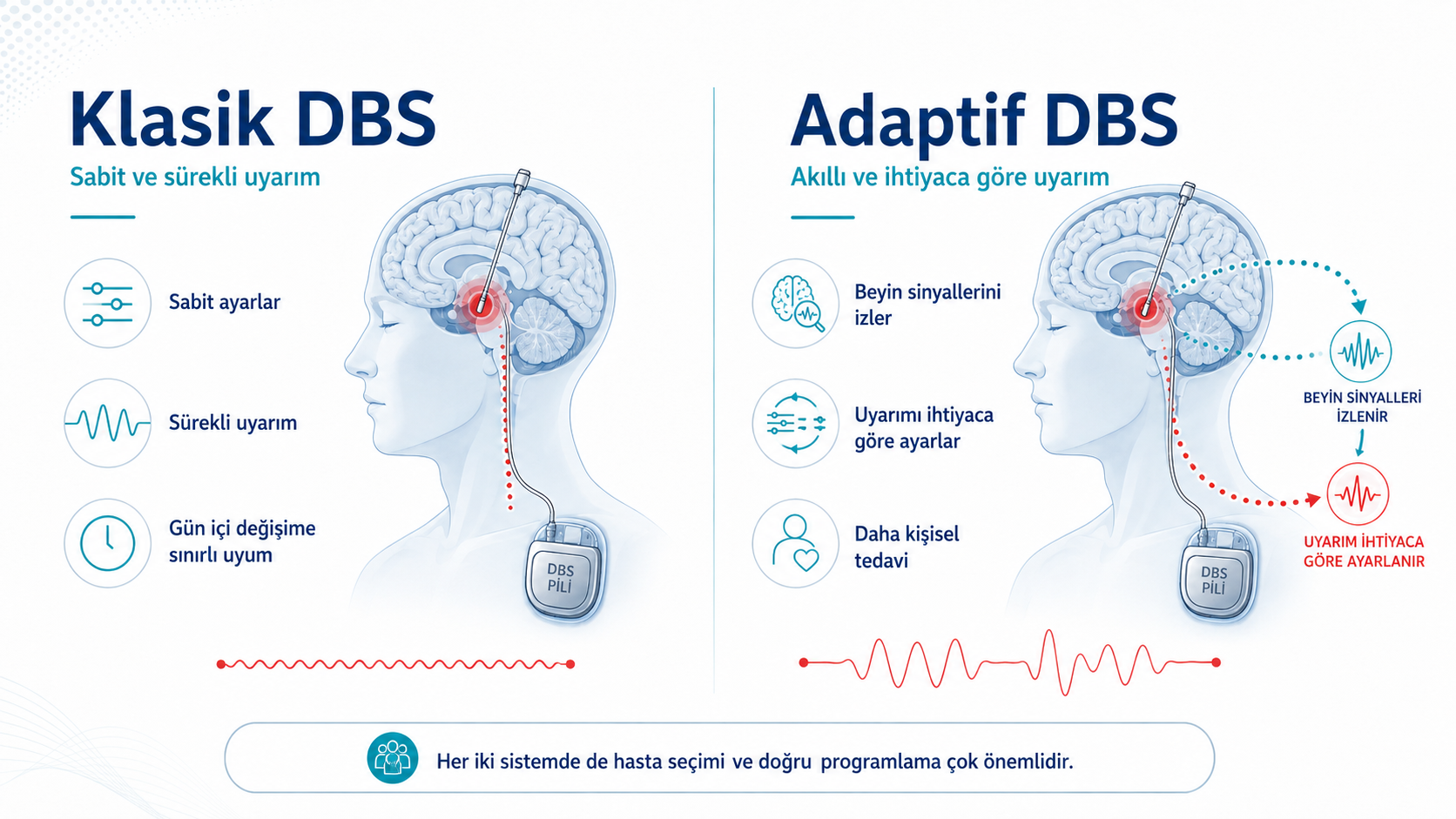
In conventional DBS systems, electrodes deliver electrical stimulation to specific areas of the brain associated with movement control.
In adaptive DBS systems, electrodes not only deliver stimulation; they can also monitor electrical signals in the brain. The system tracks specific brain signals believed to be associated with Parkinson’s symptoms and can adjust the intensity of stimulation within safe limits predetermined by the physician.
In other words, the system:
- Listens to the brain’s electrical activity.
- Detects changes in treatment needs.
- Increases or decreases stimulation within predetermined limits.
For this reason, adaptive DBS is sometimes “a brain pacemaker that listens to the brain”.
How does it differ from conventional DBS?
Conventional DBS continuously delivers preprogrammed stimulation. Adaptive DBS, on the other hand, aims to modify stimulation according to the brain’s electrical activity at that moment.
For example, a patient may need more stimulation during a period when medication effects are wearing off and less stimulation during a period when medication effects are strong. By adapting better to this variability, adaptive DBS aims to provide more balanced symptom control throughout the day.
However, the system does not make decisions entirely on its own. Which brain signal will be monitored, how much stimulation can be increased or decreased, and the safe limits are determined by physicians experienced in DBS.
What does scientific research show?
A small study published in 2024 that evaluated four patients with Parkinson’s disease reported that personalized adaptive DBS could improve some motor symptoms and quality of life compared with clinically optimized conventional DBS [1]. However, because the number of patients was very low, these results need to be confirmed in larger studies.
The larger ADAPT-PD study, published in 2025, showed that long-term home use of adaptive DBS is feasible. Most patients who completed the evaluation chose to continue with adaptive DBS. While providing motor control similar to conventional DBS, the adaptive system used less electrical energy in some programs [2]. However, the study does not prove that adaptive DBS is superior to conventional DBS in every patient.
In February 2025, the US Food and Drug Administration approved the use of an adaptive stimulation feature for Parkinson’s disease in certain DBS systems [3]. This development was an important step in the transition of adaptive DBS from a method used only in research laboratories to clinical practice. System availability and approval status may vary by country.
Is DBS that works according to walking possible?
In Parkinson’s disease, walking difficulties, freezing episodes, and falls may not always respond adequately to conventional DBS.
A small study of five patients published in 2026 evaluated an experimental system that modified stimulation according to different phases of the patient’s gait. Researchers reported that the system could monitor brain signals during walking and reduce falls in some patients [4].
However, this method is not yet part of routine treatment. Because the study included very few patients, larger and longer-term studies are needed.
Is it suitable for every patient with Parkinson’s disease?
Adaptive DBS is not suitable for every patient with Parkinson’s disease. First, the patient must generally be an appropriate candidate for DBS treatment.
In addition, it must be possible to record a reliable brain signal from the electrodes that can guide treatment. In some patients, a sufficiently strong or clear signal may not be obtained. Therefore, patient selection, surgery performed at the correct target, and careful device programming remain important.
Does it stop Parkinson’s disease?
No. Adaptive DBS has not been shown to stop Parkinson’s disease or eliminate the loss of nerve cells underlying the disease.
The goal is to better control symptoms such as tremor, slowed movement, muscle stiffness, and motor fluctuations throughout the day in appropriate patients. Adaptive DBS is not a miracle treatment that replaces conventional DBS, but a new technology intended to make treatment more personalized and dynamic.
Conclusion
Rather than delivering the same continuous stimulation to the brain, adaptive DBS aims to monitor the brain’s electrical activity and adjust treatment according to the need at that moment.
Initial research is promising. However, it is not yet known with certainty which patients will benefit more from adaptive DBS than from conventional DBS. Despite new technologies, appropriate patient selection, accurate surgical targeting, and programming by an experienced team continue to form the foundation of successful DBS treatment.
References
- 1. Oehrn CR, et al. Chronic adaptive deep brain stimulation versus conventional stimulation in Parkinson’s disease: a blinded randomized feasibility trial. Nature Medicine. 2024;30:3345–3356. doi:10.1038/s41591-024-03196-z.
- 2. Bronte-Stewart HM, et al. Long-Term Personalized Adaptive Deep Brain Stimulation in Parkinson Disease: A Nonrandomized Clinical Trial. JAMA Neurology. 2025;82:1171–1180. doi:10.1001/jamaneurol.2025.2781.
- 3. US Food and Drug Administration. Premarket Approval Supplement P960009/S478: Adaptive Deep Brain Stimulation. Approval date: February 20, 2025.
- 4. Louie KH, et al. Adaptive deep brain stimulation for dynamic gait control in Parkinson’s disease: a randomized feasibility trial. Nature Medicine. 2026. doi:10.1038/s41591-026-04434-2.