
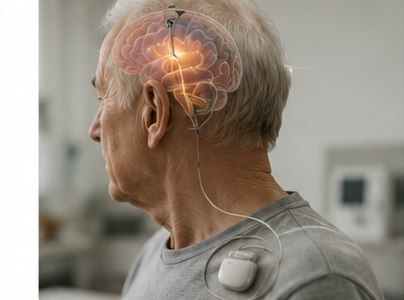
Deep brain stimulation is an effective treatment that can reduce certain motor symptoms of Parkinson’s disease and medication-related fluctuations. However, not every patient with Parkinson’s disease is a candidate for DBS.
The success of treatment depends not only on correct electrode placement and proper device programming, but also on selecting the right patient is important. The current approach recommends making a decision based not only on the patient’s age or disease duration, but by considering their symptoms, medication response, cognitive status, expectations, and overall health together [1,2].
In which patients is DBS most often considered?
DBS is generally considered for patients with a confirmed diagnosis of Parkinson’s disease who continue to have motor problems affecting daily life despite medication treatment.
DBS evaluation may be considered especially in the following situations:
- -The medication effect wearing off early during the day and frequent “off” periods occurring
- -The development of medication-related involuntary excessive movements, known as dyskinesias
- -Severe tremor that cannot be adequately controlled with medication
- -Inability to increase medication doses because of side effects
- -Symptoms significantly affecting work life, daily activities, or independence
The symptoms that DBS improves most effectively are generally slowness of movement, muscle stiffness, and certain types of tremor that respond to levodopa [1,3].
Why is the levodopa test important?
One of the most important stages of patient evaluation is measuring how much the symptoms respond to levodopa.
The patient is examined first without medication or in the “off” state, and then in the “on” state, when levodopa is effective. Motor symptoms that improve markedly with medication are generally more likely to improve with DBS as well.
In some traditional selection systems, improvement of approximately 30 percent or more in motor findings was considered sufficient. However, today this rate should not be used alone as a strict criterion for acceptance or rejection. For example, some patients who do not respond very well to levodopa but have severe, treatment-resistant tremor may still benefit from DBS [1,2].
Which symptoms respond less well to DBS?
DBS does not improve all symptoms of Parkinson’s disease to the same extent.
Benefit may be limited, particularly for the following problems that do not respond to levodopa:
- -Advanced balance impairment and frequent falls
- -Speech impairment
- -Difficulty swallowing
- -Freezing of gait in advanced stages
- -Memory and thinking problems
- -Urinary, blood pressure, or other autonomic symptoms
In some patients, speech and balance problems may persist after surgery and may even worsen because of the natural progression of the disease or stimulation. Therefore, the specific complaint the patient expects treatment to improve should be clearly discussed before surgery [1].
Is age alone a barrier?
There is no definitive upper age limit for DBS that applies to everyone.
However, as age increases, cognitive problems, balance impairment, and surgical risks may become more likely. Therefore, biological age, independence in daily life, brain MRI findings, and coexisting conditions may be more important than chronological age.
Young age alone is also not sufficient for DBS. Motor complications must significantly affect the patient’s life, and the expected benefit of surgery must outweigh the risks [1,2].
Why are memory and mental health evaluated?
A detailed neuropsychological and psychiatric evaluation is performed before DBS surgery.
Advanced dementia, significant cognitive impairment affecting decision-making capacity, uncontrolled psychosis, or severe untreated depression may pose significant risks for DBS.
Mild cognitive problems are not always a definitive barrier. The type of problem, rate of progression, impact on daily life, and which DBS target will be selected are evaluated together [1,2].
Why is a brain MRI performed?
Preoperative MRI is used to assess:
- -Vascular disease in the brain
- -Previous hemorrhages or strokes
- -Significant brain atrophy
- -Structural problems that could affect the target area or electrode trajectory
.
MRI is also used to plan the safe trajectory for electrode placement and the target point. Imaging findings alone do not determine the decision; they complement the clinical evaluation.
Is disease duration important?
In the past, DBS was mostly considered in fairly advanced stages of Parkinson’s disease. Today, patients may not need to wait for years after severe motor fluctuations and dyskinesias begin.
However, surgery is not rushed in the very early stage, when the diagnosis has not yet been confirmed. A sufficient disease duration is generally needed to reduce the likelihood of atypical parkinsonism and to observe the course of symptoms over time. Some current recommendations state that DBS may be considered after at least approximately four years of disease duration in appropriately selected younger patients [3].
How is the decision for DBS made?
The decision for DBS is not made based solely on an MRI scan or a single examination.
The evaluation generally includes the following stages:
- -Examination by a neurologist experienced in movement disorders
- -Motor assessment with and without medication
- -Neuropsychological testing
- -Psychiatric evaluation
- -Brain MRI examination
- -Neurosurgical and anesthesia evaluation
- -Discussion of the patient’s goals and expectations
The final decision should be made by a multidisciplinary team including a neurologist, functional neurosurgeon, neuropsychologist, psychiatrist, and other specialists when necessary [1,2].
Does DBS stop Parkinson’s disease?
No. DBS does not eliminate Parkinson’s disease and is not a treatment that has been shown to stop disease progression.
The goal is to better control motor fluctuations, dyskinesias, tremor, slowness of movement, and muscle stiffness, especially in appropriate patients. Patients may continue taking medication after surgery. How much the medication dose can be reduced varies according to the patient and the selected brain target.
Conclusion
The most appropriate candidate for DBS in Parkinson’s disease is a patient with a correct diagnosis, motor symptoms that respond to levodopa, medication-related fluctuations or dyskinesias, cognitive and psychiatric suitability for surgery, and realistic expectations.
However, no single age, disease duration, or test result applies to all patients.
In DBS, the right question should not be “Can a brain pacemaker be implanted in a patient with Parkinson’s disease?” but rather, “Can this patient’s most significant symptoms be improved safely and meaningfully with DBS?”
References
- 1. Wagle Shukla A, et al. Patient, target, device, and program selection for deep brain stimulation in Parkinson’s disease. NPJ Parkinson’s Disease. 2025. doi:10.1038/s41531-025-01015-x.
- 2. Safarpour D, et al. Consensus expert recommendations for referral of Parkinson’s disease patients for deep brain stimulation surgery. NPJ Parkinson’s Disease. 2026. doi:10.1038/s41531-025-01241-3.
- 3. Höglinger GU, et al. Diagnosis and treatment of Parkinson’s disease: guideline of the German Society for Neurology. Neurological Research and Practice. 2024;6:30. doi:10.1186/s42466-024-00325-4.
- 4. Artusi CA, Lopiano L, Morgante F. Deep brain stimulation selection criteria for Parkinson’s disease: time to go beyond CAPSIT-PD. Journal of Clinical Medicine. 2020;9:3931. doi:10.3390/jcm9123931.