
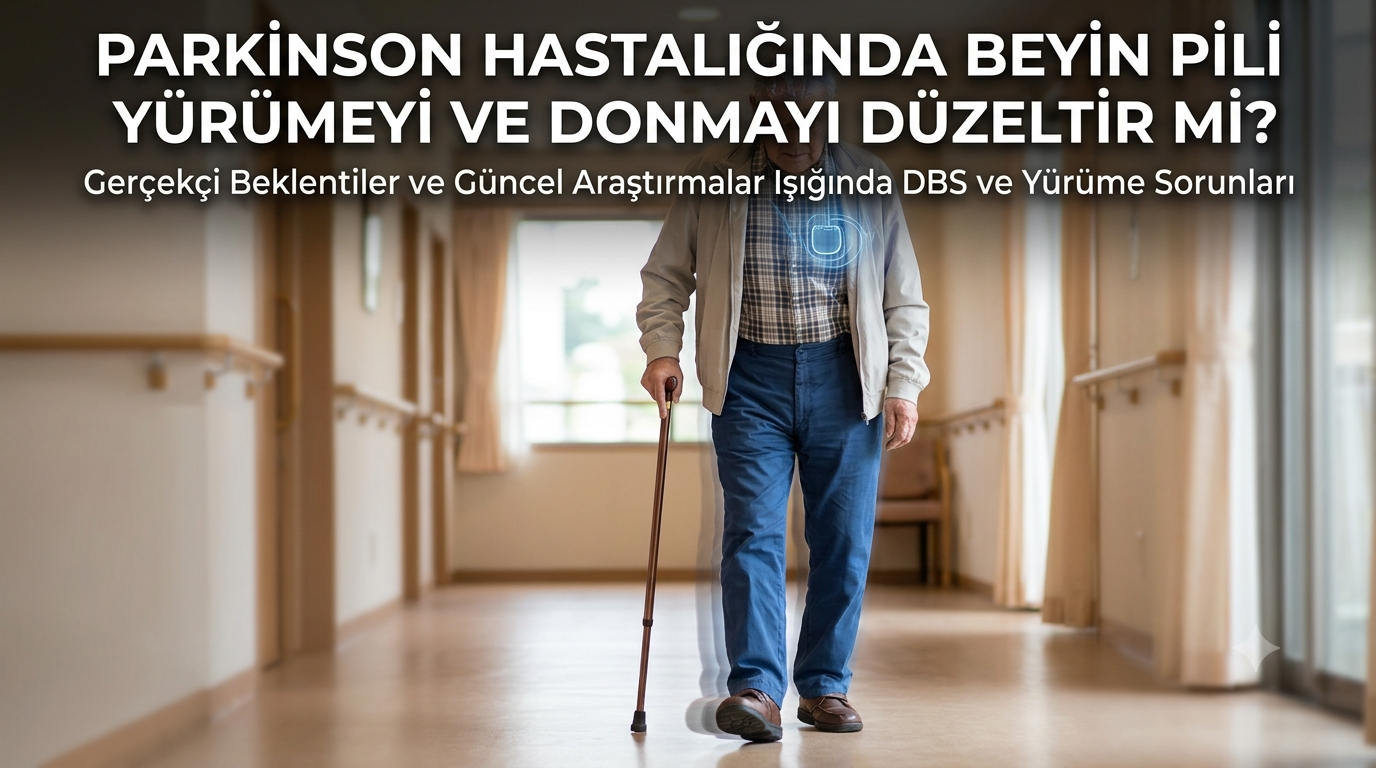
Short answer: Yes, in some patients; however, the effect of deep brain stimulation on walking is not as predictable as its effect on hand tremor or muscle stiffness.
In Parkinson’s disease, the term “walking problem” may refer to different symptoms. Shortened steps, difficulty starting to walk, the sensation that the feet are stuck to the ground, freezing while turning, imbalance, and a tendency to fall do not arise through the same mechanism. Therefore, a brain pacemaker should not be expected to improve all of these symptoms to the same extent.
What is freezing of gait?
Freezing of gait is a condition in which a patient is unable to move their feet forward for a short period even though they want to walk. Patients often describe it as “my feet are stuck to the ground.”
Freezing may occur especially:
- -When starting to walk,
- -When turning,
- -When passing through a narrow space or doorway,
- -When approaching a destination,
- -In crowded or stressful environments,
- -While doing another task at the same time
.
Even if freezing lasts only a few seconds, it can lead to loss of balance and falls. It can also significantly limit the patient’s ability to go out alone, perform daily activities, and maintain independence.
For which walking problems may a brain pacemaker be more effective?
Deep brain stimulation may be effective for Parkinson’s disease symptoms such as slowness of movement, muscle stiffness, tremor, and “off periods” caused by the wearing off of medication effects during the day.
If walking difficulty and freezing occur especially during off periods, when the medication effect is wearing off, and improve markedly when levodopa is taken, the likelihood of benefiting from a brain pacemaker is generally higher. Previous studies have shown that the preoperative response to levodopa is important in predicting how walking will respond to DBS. [1]
In a secondary analysis of the EARLYSTIM study, among patients with Parkinson’s disease and early motor complications, the proportion of those with freezing of gait decreased from 52% to 34% in the DBS group over two years of follow-up, while no significant change was observed in the group receiving medication treatment alone. [2]
However, this result does not mean that a brain pacemaker will improve every type of freezing. By reducing off periods, DBS may also reduce freezing that occurs during these periods in some patients. Freezing that persists during the on period, when medication is effective, and balance impairment that becomes prominent in advanced stages may have a more limited or variable response.
What does the research show?
A current systematic review and meta-analysis published in 2026, evaluating a total of 905 patients across 31 studies, showed a modest average improvement in scales assessing freezing of gait after DBS. However, the results varied substantially according to the brain region stimulated, the frequency used, and whether the assessment was performed during medicated or unmedicated periods. [3]
The most important message of these findings is that there is no single answer that applies to all patients, such as “DBS improves freezing” or “DBS is ineffective for freezing.” The type of freezing and the conditions under which it occurs should be evaluated in detail.
Why might walking not improve sufficiently after a brain pacemaker?
Walking is not a simple movement controlled by only one area of the brain. It requires initiating movement, maintaining rhythm, balance, attention, visual perception, and adaptation to environmental conditions.
For this reason, results may be more limited in the following situations:
- -Freezing persists during the on period independently of medication,
- -There is marked loss of balance and frequent falls,
- -Attention and planning during walking are significantly affected,
- -Axial symptoms of advanced-stage disease are predominant,
- -There are orthopedic, spinal, or peripheral nerve problems in addition to Parkinson’s disease,
- -Device settings and medications have not been adjusted according to the patient’s needs.
DBS does not completely eliminate Parkinson’s disease and does not stop the natural progression of the disease. In the years after surgery, new walking and balance problems may arise due to disease progression.
Can walking worsen after a brain pacemaker?
Although this is not an expected outcome in every patient, walking or balance problems may develop or become more pronounced after surgery in some patients.
A systematic review published in 2025 evaluated studies reporting worsening of gait and balance after bilateral subthalamic nucleus stimulation. In controlled consecutive patient cohorts, this was reported in 15.9% of patients who underwent DBS and 5.8% of patients who received best medical treatment. However, because there were important methodological differences among the studies, these rates cannot be directly applied to every patient. [4]
Worsening of walking is not always a direct result of surgery. Disease progression, excessive reduction of medications, stimulation affecting unintended neural pathways, or inappropriate programming settings may also play a role. Therefore, postoperative follow-up is not complete simply by turning on the device.
How is the preoperative evaluation performed?
The decision to use a brain pacemaker is not made based solely on a diagnosis of Parkinson’s disease or the duration of the disease. Especially when expectations related to walking are involved, it is important to answer the following questions:
- -Does freezing occur during the off period, when the medication effect is wearing off, or during the on period?
- -To what extent do step length, walking speed, and freezing change when levodopa is taken?
- -Under what conditions does the patient fall?
- -Are there significant balance, speech, or cognitive problems?
- -What is the patient’s primary expectation from DBS?
- -Have the symptoms expected to improve and those not expected to improve been explained to the patient realistically?
In an ideal evaluation, the patient’s movement examinations during medicated and unmedicated periods are compared. In patients who require it, a detailed gait assessment, neuropsychological evaluation, and brain imaging are performed. It is important for patient selection to be carried out by an experienced team in which specialists in neurology, functional neurosurgery, psychiatry, or neuropsychology work together. [5]
Why is programming important?
Correct electrode placement is one of the fundamental requirements of treatment; however, it is not sufficient on its own. The direction, intensity, frequency, and duration of electrical stimulation are adjusted for the individual patient.
In some patients, tremor may improve rapidly during initial programming, whereas finding the optimal settings for walking may take longer. While standard high-frequency stimulation reduces slowness of movement and stiffness, different frequencies or stimulation patterns may be tried in selected patients.
During adjustment, simply taking a few steps in the examination room may not be sufficient. Turning, narrow spaces, starting to walk, dual-tasking, and conditions that the patient finds difficult in daily life should also be assessed as much as possible.
Can adaptive DBS improve walking more effectively?
Most systems used today continuously deliver predetermined electrical stimulation. Adaptive DBS systems aim to modify stimulation according to need by monitoring electrical signals in the brain or the patient’s movement.
Small and experimental studies evaluating adaptive DBS systems that provide stimulation according to the phase of gait have reported improvements in some walking measures. [6] Another early-stage study that automatically adjusted stimulation using beta activity in the brain also observed positive results for walking and freezing. [7]
However, these studies include small numbers of patients, and some are preliminary studies that have not yet been published in a peer-reviewed journal. Therefore, it cannot yet be concluded that adaptive DBS is a standard and proven treatment for freezing of gait.
Conclusion
A brain pacemaker may reduce off periods, slowness of movement, and certain medication-responsive walking problems in appropriately selected patients with Parkinson’s disease. The likelihood of benefit is higher especially for freezing that occurs during the off period and improves with levodopa.
In contrast, freezing that persists during the on period, advanced balance impairment, and axial symptoms related to disease progression may have a more variable response. Treatment success depends not only on surgery but also on correct patient selection, electrode location, device programming, medication adjustments, and long-term follow-up.
Therefore, before surgery, the question “Will a brain pacemaker improve my walking?” should be preceded by the question “What type of walking problem am I experiencing, and how does this symptom respond to levodopa?”
This article has been prepared for general informational purposes. It does not replace individualized diagnosis or treatment recommendations.
References
- 1. Schlenstedt C, Shalash A, Muthuraman M, Falk D, Witt K, Deuschl G. Effect of high-frequency subthalamic neurostimulation on gait and freezing of gait in Parkinson’s disease: a systematic review and meta-analysis. European Journal of Neurology. 2017;24(1):18–26.
- 2. Barbe MT, Tonder L, Krack P, et al. Deep Brain Stimulation for Freezing of Gait in Parkinson’s Disease With Early Motor Complications. Movement Disorders. 2020;35(1):82–90.
- 3. Behboodi M, Abdollahifard S, Assadian K, et al. Deep brain stimulation for freezing of gait in Parkinson’s disease: An updated systematic review, meta-analysis, and a single-center clinical experience. Neurosurgical Review. 2026;49(1):397.
- 4. Janssen Daalen JM, Selvaraj A, Arnts H, et al. Gait and balance worsening after bilateral deep brain stimulation of the subthalamic nucleus for Parkinson’s disease: a systematic review. BMJ Neurology Open. 2025;7(1):e000898.
- 5. Pollak P. Deep brain stimulation for Parkinson’s disease—patient selection. Handbook of Clinical Neurology. 2013;116:97–105. PubMed
- 6. Louie KH, Balakid JP, Bath JE, et al. Adaptive deep brain stimulation timed to gait phase improves walking in Parkinson’s disease. medRxiv. 2025.
- 7. Wilkins KB, Petrucci MN, Lambert EF, et al. Beta Burst-Driven Adaptive Deep Brain Stimulation Improves Gait Impairment and Freezing of Gait in Parkinson’s Disease. medRxiv. 2024.