
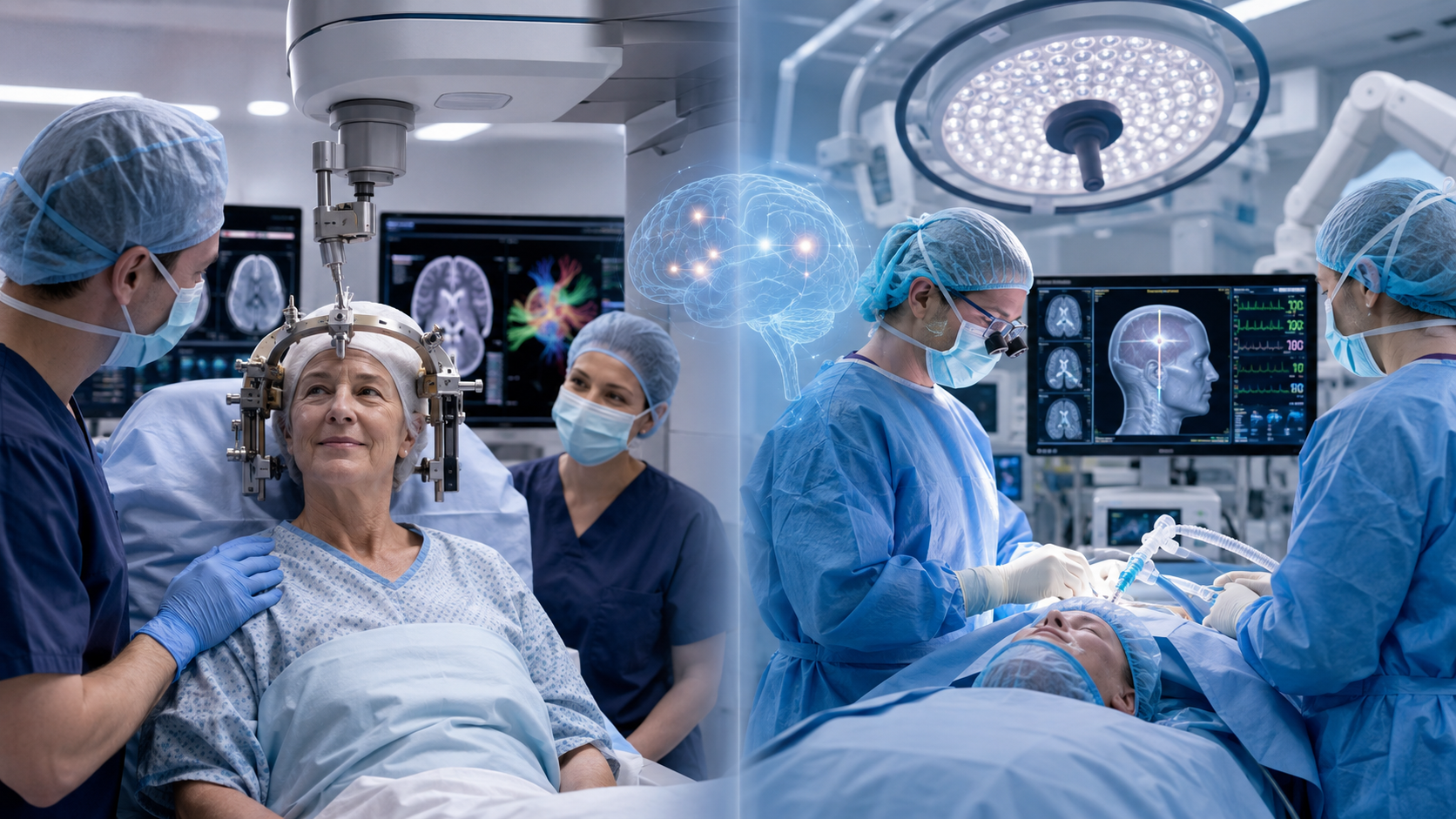
One of the most common questions asked by patients who will undergo brain pacemaker surgery, or deep brain stimulation (DBS) surgery, is:
“Will I be awake during surgery?”
The short answer: Not always.
Deep brain stimulation surgery can be performed both while the patient is awake and under general anesthesia, meaning while the patient is fully asleep. Today, thanks to advanced imaging and surgical planning methods, successful outcomes can be achieved with both approaches in appropriate patients [1–4]. A randomized study also showed that motor improvement after DBS surgery performed awake and under general anesthesia was similar in patients with Parkinson’s disease [1].
Why is the patient kept awake during surgery?
In deep brain stimulation surgery, electrodes must be placed in very small, specific areas of the brain with millimetric precision.
In the traditional method, the patient is awake during the stage when the electrodes are placed. Local anesthesia is applied to the head area to ensure that the patient does not feel pain.
During surgery, the surgeon can speak with the patient; ask them to move their hand or foot, observe whether tremor decreases, or deliver temporary electrical stimulation to assess whether an unwanted effect occurs in speech, movement, or other functions [1].
Some centers also use microelectrode recordings. With this method, the electrical activity of nerve cells in the targeted brain region is recorded during surgery. This can provide the surgeon with additional information about whether the electrode has reached the correct brain region [1].
For this reason, awake surgery has been the traditional method of DBS surgery for many years.
Does being awake mean remaining completely awake throughout the surgery?
No.
The term “awake DBS” does not mean that the patient remains completely awake from the beginning to the end of surgery without receiving any medication.
The approach may vary depending on the center and the surgical technique used. In some methods, it is sufficient for the patient to be awake during certain stages. The main goal is to be able to communicate with the patient when necessary and to perform certain neurological tests while placing the electrodes.
Placement of the battery unit in the chest area, which supplies electricity to the electrodes, can generally be performed under anesthesia. For example, in the GALAXY study, in patients in the awake group, the stage in which the battery and connection system were placed after the brain electrodes were inserted was performed under general anesthesia [1].
Can deep brain stimulation surgery also be performed while the patient is fully asleep?
Yes.
In recent years, DBS electrodes can also be placed while the patient is under general anesthesia. This method is often called “asleep DBS”, meaning DBS performed under general anesthesia.
In this method, rather than relying on the patient’s clinical responses during surgery, imaging methods performed before and during surgery are used in particular. Detailed MRI and CT images, stereotactic surgical planning systems, and intraoperative imaging performed at some centers help place the electrode at the correct location [2–4].
It should not be assumed that microelectrode recordings can be performed only in awake patients. Depending on the anesthesia technique used, microelectrode recordings can also be performed under general anesthesia. Indeed, microelectrode recordings were used in both the awake and general anesthesia groups in the GALAXY study [1].
Is surgery performed under general anesthesia less successful?
Current scientific evidence does not show this.
Studies directly comparing awake and asleep DBS surgery in patients with Parkinson’s disease have not shown a significant difference between the two methods in terms of improvement in motor symptoms [1–4].
In one of the most important studies on this topic, the GALAXY randomized clinical trial included 110 patients with Parkinson’s disease who underwent STN-DBS surgery while awake or under general anesthesia. At six-month follow-up, no significant difference was found between the two groups in terms of motor improvement [1]. Surgery under general anesthesia was rated as less burdensome by patients, and the surgery duration was, on average, 26 minutes shorter.
Another randomized study reported that motor improvement at six months after STN-DBS performed under general anesthesia was similar to the results achieved with the awake method [2].
Studies evaluating larger patient groups have also generally reported similar results between awake and asleep DBS in terms of motor improvement, quality of life, and reduction in medication use [3,4].
Therefore, today:
“A brain pacemaker must be implanted while the patient is awake.”
is not an accurate general rule.
What is the advantage of surgery performed under general anesthesia?
One of the most important advantages is patient comfort.
Surgery performed under general anesthesia may be more comfortable, especially for patients who have significant anxiety about surgery, have difficulty remaining in the same position for a long time, or experience pronounced tremor, muscle contractions, or involuntary movements during the period when medications are stopped.
In the GALAXY study as well, patients who underwent surgery under general anesthesia rated the surgical process as less burdensome than patients who underwent awake surgery [1]. In addition, the ability to operate under general anesthesia on patients who may have difficulty tolerating awake surgery because of severe restlessness, anxiety, or painful dystonia may be an important advantage [1].
What is the advantage of awake surgery?
One of the main advantages of awake surgery is that, while placing the electrode, the patient can be evaluated directly on a clinical basis.
For example, when the electrode is temporarily stimulated:
- -Does tremor decrease?
- -Is there improvement in movement?
- -Does speech impairment occur?
- -Do involuntary contractions develop in the face or arms and legs?
- -Does any other side effect that bothers the patient occur?
effects such as these can be evaluated during surgery [1].
This information may help determine the most appropriate electrode location in some patients and with some surgical techniques.
However, with advances in modern imaging methods, the ability to visualize target regions of the brain in much greater detail before surgery has enabled some centers to place DBS electrodes under general anesthesia without clinical testing [1–4].
Which is better: awake DBS or asleep DBS?
In fact, the right question is often not “Which is better?” but “Which method is more appropriate for this patient?”.
This is because the success of DBS surgery is not determined solely by whether the patient is awake or asleep during surgery.
More important factors are:
- -selecting the right patient,
- -determining the brain target appropriate for the patient,
- -safely placing the electrode at the correct location,
- -correctly programming the device after surgery,
- -and having the entire process managed by an experienced team.
Current clinical studies show that, when an appropriate technique is used at experienced centers, both awake and asleep DBS surgery can be effective options [1–4].
Conclusion
A patient undergoing deep brain stimulation surgery does not necessarily need to remain awake throughout the procedure.
Today, DBS surgery can be performed while the patient is awake or under general anesthesia. Both approaches have their own advantages. Comparative studies in patients with Parkinson’s disease show that, when appropriate surgical techniques are used, both methods can provide similar motor outcomes [1–4].
The choice of method should be determined individually based on the patient’s characteristics, the targeted brain region, the surgical and imaging technologies to be used, and the experience of the surgical team.
Therefore, the most important aspect of deep brain stimulation surgery is not whether the patient is awake or asleep, but whether the electrode is placed safely and precisely at the correct target.
References
1. Holewijn RA, Verbaan D, van den Munckhof PM, et al. General Anesthesia vs Local Anesthesia in Microelectrode Recording-Guided Deep-Brain Stimulation for Parkinson Disease: The GALAXY Randomized Clinical Trial. JAMA Neurol. 2021;78(10):1212–1219. doi:10.1001/jamaneurol.2021.2979.
2. Engelhardt J, Caire F, Damon-Perrière N, et al. A Phase 2 Randomized Trial of Asleep versus Awake Subthalamic Nucleus Deep Brain Stimulation for Parkinson’s Disease. Stereotact Funct Neurosurg. 2021;99(3):230–240. doi:10.1159/000511424.
3. Brodsky MA, Anderson S, Murchison C, et al. Clinical outcomes of asleep vs awake deep brain stimulation for Parkinson disease. Neurology. 2017;89(19):1944–1950. doi:10.1212/WNL.0000000000004630.
4. Chen T, Mirzadeh Z, Chapple KM, et al. Clinical outcomes following awake and asleep deep brain stimulation for Parkinson disease. J Neurosurg. 2019;130(1):109–120. doi:10.3171/2017.8.JNS17883.